The common metal types used for non-ferrous castings and their properties
How non-ferrous castings are made, and why aluminium, copper and zinc are valued for their corrosion resistance, conductivity and malleability.
Over the last few decades, the metalworking sector has been endowed with numerous production processes, including turning raw materials into refined finished products. In these processes, ferrous and non-ferrous metal alloys are heat-treated, rolled, extruded and forged. The non-ferrous metal group has a wide range of materials, with properties that make them desirable for use in industries requiring higher conductivity and corrosion resistance.
What are non-ferrous metal castings?
Non-ferrous castings are a very specialised class of this multi-layered industrial practice. To make these castings, metal is heated and melted so that its crystalline structure breaks down and it liquefies. The metallic alloy that was previously rigid is channelled into hollow moulds to give it the desired shape. The unrefined molten metal cools and solidifies, and is then given a special surface finish.
Characteristics of non-ferrous metals
The most essential property of non-ferrous castings is that they are non-magnetic, making them suitable for use in certain electronic applications. Owing to the basic molecular make-up of non-ferrous metals, the possible susceptibility to corrosion is eliminated.
Iron-free metals also offer electrical conductivity, which results in superior wiring and electrical contacts. Non-ferrous metals such as aluminium are more valuable and better at resisting corrosion than ferrous metals, allowing an aluminium die casting manufacturer to provide a high-quality service. They can also be distinguished by their malleability and are used for an extensive range of commercial applications.
Metal types used for making non-ferrous castings and their properties
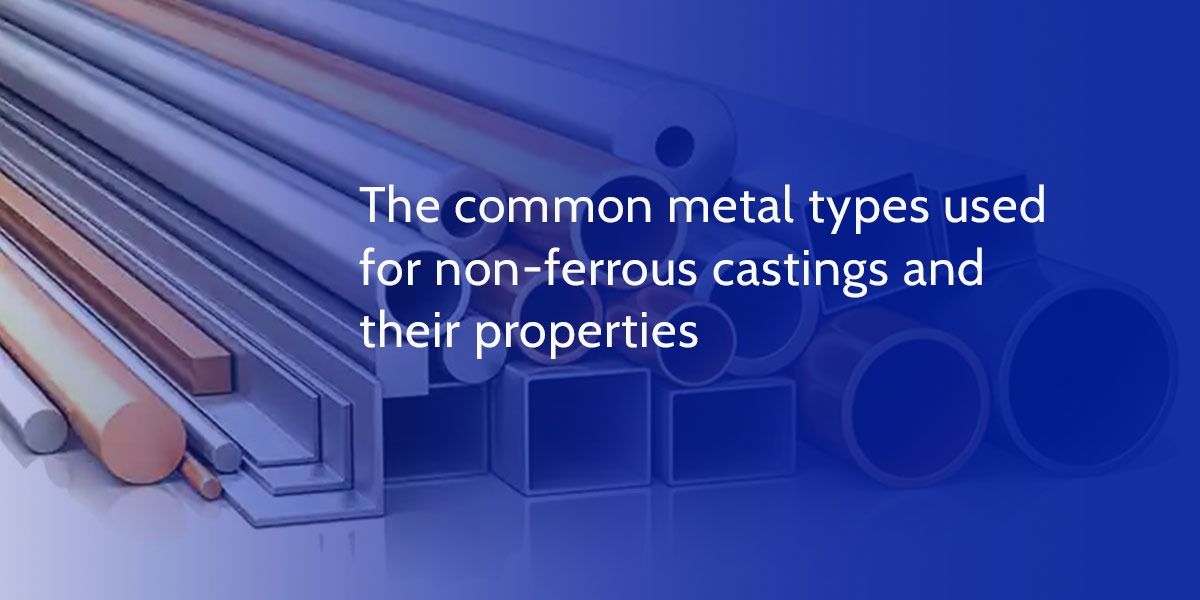
Non-ferrous metals are free of iron, and this exclusive group includes aluminium, copper, bronze, zinc and magnesium, amongst a few others. Combinations of these metals give rise to new molecular structures that have multiple applications when specialised finishing techniques are applied.
- Aluminium
Aluminium is highly resistant to corrosion and is mainly obtained from bauxite ore. It is a brilliant conductor of electricity and heat while being a good reflector of light. Aluminium is soft and tough, and can be transformed into any shape by stamping, rolling, forging and spinning. It can be cast using casting methods such as chill casting, sand casting and aluminium die casting.
- Copper
Copper is extracted from ores such as copper pyrites and has been in industrial and engineering use for over a century. It is corrosion-resistant and forms excellent alloys. Being malleable and ductile, copper can be moulded into any shape, as well as joined by welding, brazing, soldering and riveting.
- Zinc
Zinc can be obtained from ores such as calamine and zinc blende, with sphalerite as the chief ore mineral. It is corrosion-resistant and becomes ductile and malleable when heated to a temperature of 100–150 °C. At this temperature it can be drawn into wires and rolled into sheets.
Non-ferrous metals have been used throughout history, from the Stone Age to 1700 BC, for making bronze weapons. Today, non-ferrous metals have multiple applications in construction, pipelines, electrical cables, toolmaking and vehicle engines.